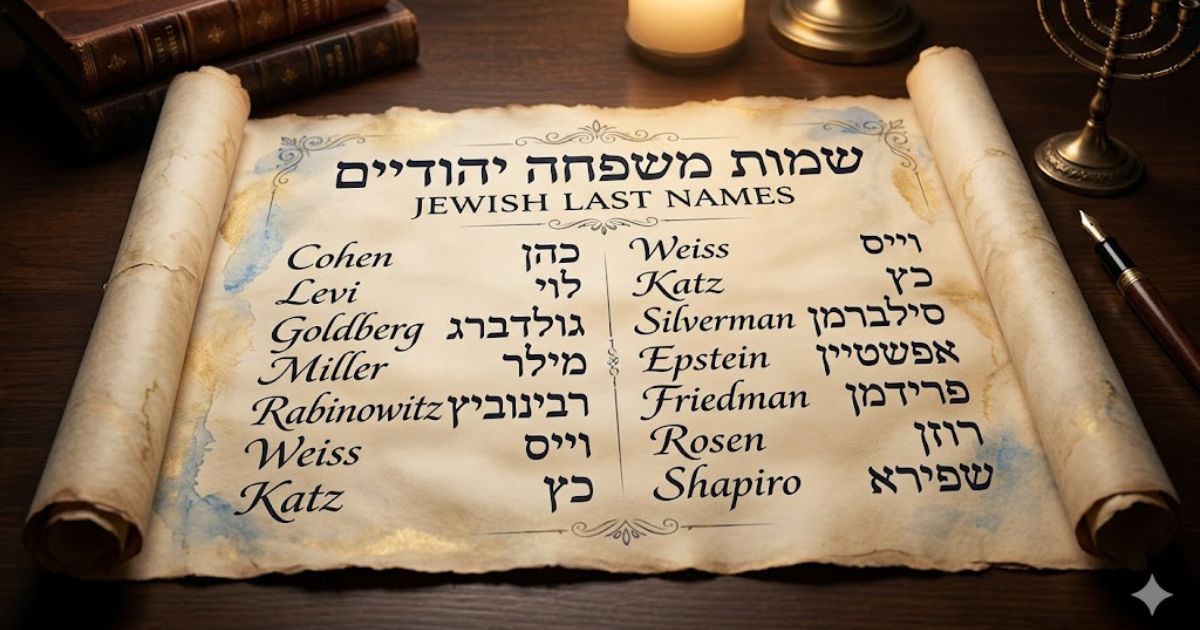
Jewish last names often reveal fascinating clues about family heritage, ancestry, and cultural identity. If you want to understand the meaning behind a surname or trace its origins, these names can offer valuable insights.
Many Jewish surnames reflect occupations, geographic locations, religious traditions, or ancestral lineage. Genealogy researchers frequently use surname meanings, historical records, and naming patterns to uncover family history and migration routes.
In this guide, you’ll explore the origins, meanings, categories, and cultural significance of Jewish surnames. You’ll also discover unique examples and historical connections that can help you better understand your roots.
Jewish Last Names and Meanings
Jewish last names often have deep cultural significance and can reveal information about a family’s ancestry, profession, or place of origin. Many surnames were adopted during periods when governments required families to use hereditary surnames.
Some Jewish last names and their meanings include:
- Cohen – Priest, referring to descendants of the ancient Jewish priestly class.
- Levy or Levi – Associated with the Tribe of Levi, which held religious responsibilities.
- Goldberg – Golden mountain.
- Rosenberg – Rose mountain.
- Friedman – Peaceful person.
- Katz – An abbreviation connected to priestly lineage.
- Horowitz – Originating from a town in Central Europe.
- Shapiro – Derived from the German city of Speyer.
- Greenberg – Green mountain.
- Silverman – Person associated with silver.
These names often symbolize family history, religious heritage, and cultural identity that continues to be valued today.
Most Common Jewish Last Names
Many Jewish surnames have become widely recognized due to their long history and broad use across Jewish communities worldwide.
Some of the most common Jewish last names include:
- Cohen
- Levy
- Levi
- Katz
- Friedman
- Rosenberg
- Goldberg
- Shapiro
- Klein
- Weiss
- Greenberg
- Feldman
- Stein
- Kaplan
- Horowitz
These surnames remain popular because they are strongly connected to Jewish ancestry, tradition, and family lineage. Many families continue to proudly carry these names as symbols of their heritage.
Popular Jewish Last Names
Popular Jewish last names often combine meaningful symbolism with strong historical roots. Many have remained well known across generations and are found in communities throughout North America, Europe, Israel, and beyond.
Popular examples include:
- Cohen
- Rosen
- Goldstein
- Silverman
- Bernstein
- Greenberg
- Rubin
- Adler
- Kaplan
- Mandel
- Bloom
- Grossman
- Weissman
- Berger
- Stern
These names are admired for their memorable pronunciation, rich history, and lasting cultural significance.
Unique Jewish Last Names
Some Jewish surnames are less common and stand out because of their distinctive sound, origin, or meaning. Unique names often preserve local traditions and family stories that make them especially meaningful.
Examples of unique Jewish last names include:
- Abend
- Azulai
- Benatar
- Elbaz
- Mizrahi
- Toledano
- Abarbanel
- Ziv
- Margalit
- Ben Ami
- Dayan
- Sasson
- Peretz
- Almog
- Harel
Many of these names have connections to specific regions, historical events, or notable Jewish communities, making them valuable for genealogical research.
Traditional Jewish Surnames
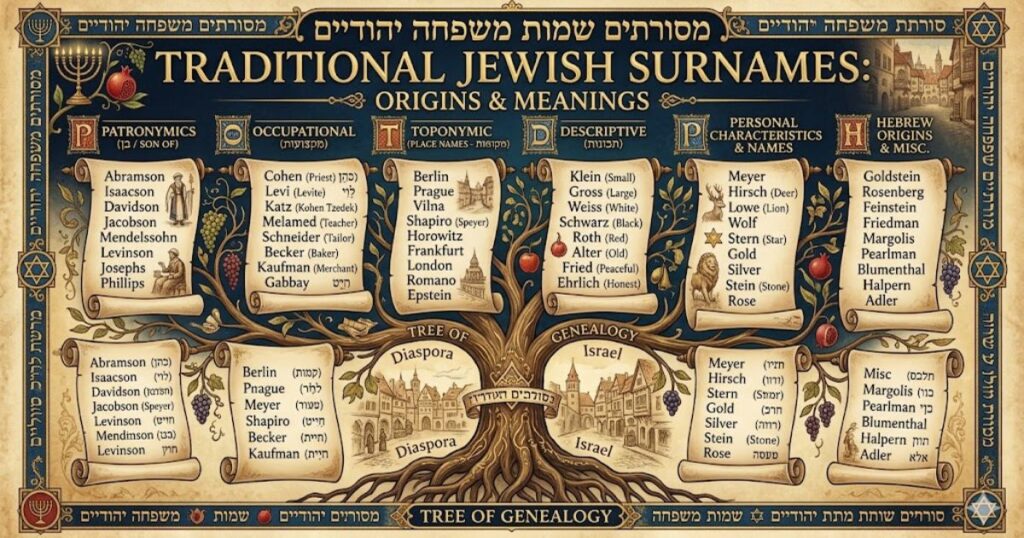
Traditional Jewish surnames often reflect ancient religious roles, family relationships, and longstanding cultural customs. These names have been passed down through generations and continue to hold special meaning.
Examples include:
- Cohen
- Levi
- Katz
- Segal
- Rabin
- Kaplan
- Horowitz
- Shapiro
- Landau
- Halpern
Traditional surnames are important reminders of Jewish history and often help families maintain a strong connection to their roots.
Ashkenazi Jewish Last Names
Ashkenazi Jewish last names originated among Jewish communities in Central and Eastern Europe. Many were influenced by German, Yiddish, Polish, Russian, and Hungarian languages.
Common Ashkenazi surnames include:
- Goldberg
- Rosenberg
- Greenberg
- Silverman
- Weiss
- Friedman
- Klein
- Steinberg
- Horowitz
- Shapiro
- Feldman
- Eisenberg
- Grossman
- Rubinstein
- Bernstein
Many Ashkenazi surnames feature elements related to nature, colors, occupations, or geographic locations. Their meanings often reflect the cultural environment in which Jewish families lived for centuries.
Sephardic Jewish Last Names
Sephardic Jewish surnames trace their roots to Jewish communities from Spain, Portugal, North Africa, and the Middle East. These names often reflect a rich blend of Hebrew, Arabic, Spanish, and Portuguese influences.
Examples include:
- Toledano
- Benveniste
- Cardozo
- Navarro
- Abecassis
- Abarbanel
- Benatar
- Elbaz
- Azulai
- Ohayon
- Cohen
- Mizrahi
- Malka
- Peretz
- Bitton
Many Sephardic surnames preserve the memory of ancestral homelands and migrations that shaped Jewish history after the expulsion from Spain in the late fifteenth century.
Occupational Jewish Last Names
Occupational surnames developed from the professions or community roles performed by ancestors. These names provide insight into how families contributed to society and local economies.
Examples include:
- Schneider – Tailor.
- Metzger – Butcher.
- Kaplan – Chaplain or religious official.
- Rabin – Rabbi.
- Melamed – Teacher.
- Goldsmith – Worker of gold.
- Silverman – Worker associated with silver.
- Kaufman – Merchant.
- Becker – Baker.
- Wechsler – Money changer.
These surnames often reflect skills, trades, and respected positions that were passed from one generation to the next.
Patronymic Jewish Last Names
Patronymic Jewish surnames are based on the name of a father or ancestor. This naming tradition helped identify family lineage and preserve ancestral connections.
Examples include:
- Ben David – Son of David.
- Ben Ami – Son of my people.
- Ben Zion – Son of Zion.
- Abramson – Son of Abraham.
- Jacobson – Son of Jacob.
- Mendelson – Son of Mendel.
- Aronson – Son of Aaron.
- Isaacson – Son of Isaac.
- Samuelson – Son of Samuel.
- Davidson – Son of David.
Patronymic surnames highlight the importance of family heritage within Jewish culture. They serve as lasting reminders of ancestral identity and continue to connect modern generations with their family history.
Jewish Last Names Derived From Places
Many Jewish surnames originated from towns, cities, regions, or countries where families once lived. These geographic surnames helped distinguish individuals and preserve connections to ancestral homelands. Over time, they became important markers of family identity and migration history.
Examples of Jewish last names derived from places include:
- Horowitz – From the town of Hořovice in the Czech Republic.
- Shapiro – Derived from Speyer, a historic city in Germany.
- Berliner – Someone from Berlin.
- Posner – Connected to the city of Poznań in Poland.
- Frankfurter – Originating from Frankfurt.
- Hamburger – Linked to Hamburg.
- Oppenheim – From the German town of Oppenheim.
- Mintz – Derived from Mainz, Germany.
- Toledano – Refers to Toledo, Spain.
- Pollack – Associated with Poland.
These surnames tell stories of movement, settlement, and resilience, reflecting the diverse paths Jewish communities followed throughout history.
Nature Inspired Jewish Last Names
Nature has long served as a source of inspiration for Jewish surnames. Many families adopted names connected to flowers, trees, mountains, colors, and precious elements, creating beautiful and symbolic family names.
Popular nature inspired Jewish last names include:
- Rosenberg – Rose mountain.
- Rosenbaum – Rose tree.
- Greenberg – Green mountain.
- Goldberg – Golden mountain.
- Blumenfeld – Flower field.
- Blum – Flower.
- Silverstein – Silver stone.
- Rubin – Ruby gemstone.
- Birnbaum – Pear tree.
- Adler – Eagle.
These names often symbolize beauty, strength, growth, prosperity, and wisdom, making them both meaningful and memorable.
Polish Jewish Last Names

Poland was home to one of the largest Jewish populations in Europe for centuries. As a result, many Jewish surnames have strong Polish influences while maintaining Hebrew, Yiddish, or German roots.
Common Polish Jewish last names include:
- Goldberg
- Rosenberg
- Horowitz
- Katz
- Weiss
- Friedman
- Klein
- Shapiro
- Rubinstein
- Abramowicz
- Lewin
- Peretz
- Feldman
- Landau
- Zylberberg
These surnames reflect the rich cultural heritage of Polish Jewish communities and continue to be recognized around the world today.
May you like also: 290+ Best Fantasy Football Names Funny Winning Ideas 2026
Jewish Last Names for Males
While surnames are generally shared by all family members, certain Jewish last names are often associated with prominent male ancestry, religious leadership, or historical family lines.
Popular Jewish last names for males include:
- Cohen
- Levi
- Katz
- Kaplan
- Rabin
- Horowitz
- Abramson
- Aronson
- Jacobson
- Davidson
- Mendelson
- Friedman
- Grossman
- Stern
- Berger
These surnames often convey qualities such as leadership, wisdom, faith, responsibility, and strong family heritage.
Jewish Last Names for Females
Jewish last names used by females are typically inherited from family lineage and carry the same historical and cultural significance. Many are admired for their elegant sound and meaningful origins.
Beautiful Jewish last names for females include:
- Rosen
- Bloom
- Blum
- Goldstein
- Silverman
- Rubin
- Margalit
- Sasson
- Ben Ami
- Adler
- Weiss
- Bernstein
- Greenberg
- Ziv
- Malka
These surnames are associated with grace, tradition, strength, and a deep connection to Jewish culture and family history.
Jewish Last Names Starting With S
Jewish surnames beginning with the letter S are common across Ashkenazi and Sephardic communities. Many have origins connected to locations, occupations, religious heritage, or personal characteristics.
Popular Jewish last names starting with S include:
- Shapiro
- Silverman
- Silverstein
- Stein
- Steinberg
- Schwartz
- Stern
- Segal
- Schneider
- Sasson
- Spiegel
- Solomon
- Sandler
- Schiff
- Siegel
These surnames remain widely recognized and continue to represent generations of Jewish ancestry, tradition, and cultural pride.
Jewish Last Names Ending in Stein
The suffix “Stein” comes from the German word meaning “stone.” Many Jewish families adopted Stein based surnames during the eighteenth and nineteenth centuries when hereditary surnames became legally required in parts of Europe. These names often combined Stein with another word to create distinctive family identities.
Popular Jewish last names ending in Stein include:
- Goldstein – Golden stone.
- Silverstein – Silver stone.
- Rubinstein – Ruby stone.
- Bernstein – Amber stone.
- Einstein – One stone or stone related surname.
- Morgenstein – Morning stone.
- Greenstein – Green stone.
- Wolfstein – Wolf stone.
- Feinstein – Fine stone.
- Perlstein – Pearl stone.
These surnames are especially common among Ashkenazi Jewish families and are admired for their strong sound, historical significance, and memorable character.
How Can You Tell If a Last Name Is Jewish?
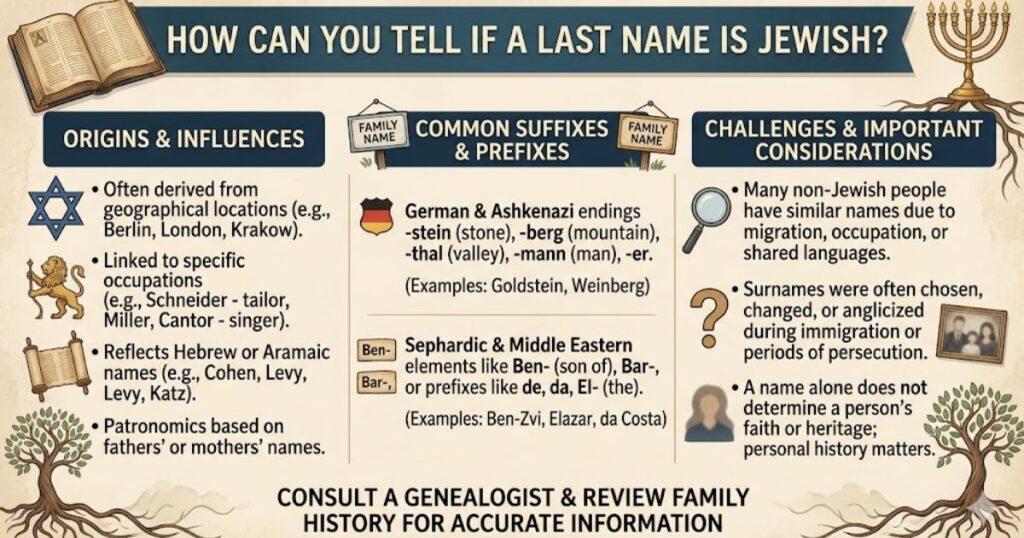
Identifying whether a last name is Jewish can be challenging because Jewish communities have lived in many countries and adopted surnames influenced by different languages and cultures. However, certain patterns can provide clues.
Common indicators of Jewish ancestry in a surname include:
- Religious names such as Cohen, Katz, or Levi.
- Hebrew based family names.
- Yiddish influenced surnames.
- Germanic surnames like Goldberg, Rosenberg, and Silverman.
- Patronymic names such as Abramson or Jacobson.
- Sephardic names connected to Spain, Portugal, or North Africa.
- Surnames associated with historic Jewish communities.
It is important to remember that a surname alone cannot definitively prove Jewish heritage. Family records, genealogy research, and cultural traditions often provide a more accurate picture of ancestry.
The History and Origins of Jewish Last Names
The history of Jewish last names spans centuries and reflects the journeys of Jewish communities across Europe, the Middle East, North Africa, and beyond. In ancient times, Jews primarily used personal names combined with references to their fathers, such as “son of” naming traditions.
Permanent family surnames became more common between the eighteenth and nineteenth centuries when governments in Austria, Germany, Russia, and other regions required Jewish families to adopt hereditary last names for legal and administrative purposes.
Many surnames were inspired by:
- Religious roles and tribal heritage.
- Occupations and trades.
- Geographic locations.
- Personal characteristics.
- Nature and precious objects.
- Family lineage and ancestry.
Over generations, these names became symbols of identity, preserving stories of migration, resilience, faith, and cultural continuity. Today, Jewish last names remain an important connection to family history and heritage.
Famous Jewish Last Names
Some Jewish surnames have become widely recognized because of influential families, scholars, artists, scientists, business leaders, and public figures who carried them throughout history.
Well known Jewish last names include:
- Cohen
- Levi
- Goldstein
- Einstein
- Shapiro
- Horowitz
- Kaplan
- Bernstein
- Rubinstein
- Greenberg
- Friedman
- Rothschild
- Adler
- Katz
- Rosenberg
These surnames are often associated with achievement, leadership, intellectual contributions, and lasting cultural influence within Jewish communities and around the world.
Rare Jewish Last Names
Rare Jewish surnames offer a fascinating glimpse into lesser known family histories and regional traditions. Many have survived through generations despite being carried by relatively small numbers of families.
Examples of rare Jewish last names include:
- Abarbanel
- Benatar
- Azulai
- Abecassis
- Ohayon
- Sasson
- Margalit
- Elbaz
- Dayan
- Almog
- Harel
- Ben Zion
- Mizrahi
- Toledano
- Zohar
These uncommon surnames often have unique origins tied to specific regions, languages, or historical communities. For genealogists and family historians, rare Jewish last names can provide valuable clues about ancestral roots and cultural heritage.
Jewish Family Names and Their Significance
Jewish family names are more than simple identifiers. They often represent centuries of heritage, religious traditions, family values, and cultural identity. Many surnames preserve stories of migration, community leadership, occupations, and ancestral connections that have been passed down through generations.
The significance of Jewish family names can often be linked to:
- Religious heritage and priestly lineage.
- Family ancestry and genealogy.
- Geographic origins and migration history.
- Occupations and community roles.
- Personal characteristics and symbolic meanings.
- Tribal connections within ancient Israel.
For many families, a Jewish surname serves as a lasting reminder of resilience, faith, and cultural continuity. These names help preserve family history while connecting modern generations to their ancestors.
Modern Jewish Last Names
Modern Jewish last names continue to evolve as Jewish communities grow and integrate into societies around the world. While many families retain traditional surnames, others have adapted spellings or adopted newer family names that reflect contemporary identities.
Popular modern Jewish last names include:
- Cohen
- Levy
- Rosen
- Gold
- Stein
- Green
- Weiss
- Rubin
- Adler
- Kaplan
- Stern
- Bloom
- Berger
- Friedman
- Shapiro
Today, modern Jewish surnames often balance historical roots with cultural adaptation. They remain important symbols of heritage while fitting naturally into diverse global communities.
Biblical Influences on Jewish Last Names
The Hebrew Bible has had a profound influence on Jewish naming traditions. Many Jewish surnames trace their origins to biblical figures, tribes, religious leaders, and sacred concepts that hold deep spiritual significance.
Examples of biblical influences on Jewish last names include:
- Cohen – Connected to the priesthood established in biblical tradition.
- Levi – Derived from the Tribe of Levi.
- Aaronson – Descendant of Aaron.
- Abramson – Descendant of Abraham.
- Jacobson – Descendant of Jacob.
- Davidson – Descendant of King David.
- Samuelson – Descendant of Samuel.
- Isaacson – Descendant of Isaac.
- Ben Zion – Son of Zion.
- Solomon – Inspired by King Solomon.
These surnames help preserve biblical heritage and often reflect values such as wisdom, faith, leadership, and devotion.
Choosing a Jewish Last Name for Family Research
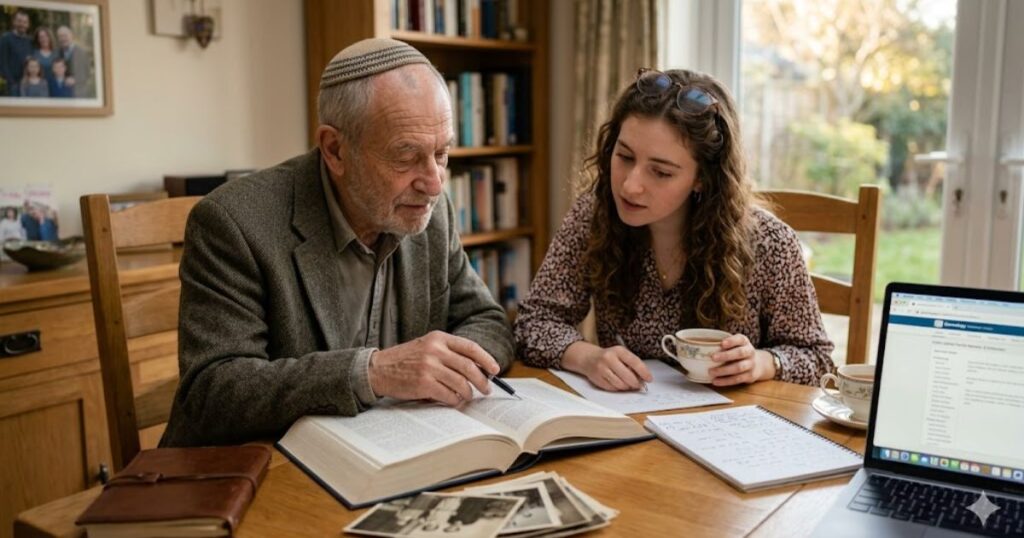
Selecting a Jewish last name for genealogy or family history research requires careful consideration of historical records and cultural context. Understanding surname origins can reveal valuable information about ancestral roots and migration patterns.
Helpful tips for researching Jewish last names include:
- Investigate family records and historical documents.
- Explore immigration and census records.
- Consider regional spelling variations.
- Research Ashkenazi and Sephardic heritage separately.
- Study occupational and patronymic naming traditions.
- Examine religious and tribal connections.
- Use genealogy databases and family history archives.
A well researched surname can unlock fascinating details about family history and provide a stronger understanding of ancestral identity.
A Complete List of Jewish Last Names by Category
Jewish surnames can be organized into several categories based on their origin, meaning, and historical background.
Religious and Priestly Names
- Cohen
- Katz
- Levi
- Segal
Occupational Names
- Kaplan
- Rabin
- Schneider
- Becker
- Melamed
Patronymic Names
- Abramson
- Aronson
- Jacobson
- Davidson
- Mendelson
Nature Inspired Names
- Rosenberg
- Rosenbaum
- Goldberg
- Greenberg
- Birnbaum
Geographic Names
- Horowitz
- Shapiro
- Berliner
- Posner
- Toledano
Ashkenazi Jewish Names
- Friedman
- Klein
- Weiss
- Rubinstein
- Bernstein
Sephardic Jewish Names
- Abarbanel
- Benatar
- Azulai
- Abecassis
- Ohayon
Rare Jewish Names
- Harel
- Almog
- Ziv
- Dayan
- Margalit
Organizing Jewish last names by category makes it easier to understand their meanings, origins, and cultural significance. Whether researching ancestry or exploring naming traditions, these categories provide a comprehensive overview of the rich heritage behind Jewish surnames.
Frequently Asked Questions
What is the most common Jewish last name?
Cohen is widely considered the most common Jewish last name and is traditionally associated with descendants of the ancient Jewish priesthood.
How do Jewish last names originate?
Jewish last names often originate from occupations, geographic locations, family lineage, religious roles, or personal characteristics adopted over centuries.
Are all people with the last name Cohen Jewish?
Not necessarily. While Cohen has strong Jewish roots, a surname alone cannot confirm a person’s religion, ethnicity, or ancestry.
What are some traditional Ashkenazi Jewish last names?
Common Ashkenazi Jewish last names include Goldberg, Rosenberg, Friedman, Shapiro, Klein, Weiss, and Rubinstein.
How can I find the meaning of my Jewish last name?
You can research family records, genealogy databases, historical archives, and surname origin resources to discover the meaning and history of your Jewish last name.
Conclusion
Jewish last names reflect a rich blend of history, culture, faith, and family heritage. From common surnames like Cohen and Levi to unique Sephardic and Ashkenazi names, each surname carries a story that connects generations. Understanding Jewish last names and their meanings can provide valuable insights into ancestry, migration patterns, occupations, and religious traditions that have shaped Jewish communities around the world.
While researching this topic, I found it fascinating how a single surname can reveal so much about a family’s past. Learning the origin and significance of Jewish surnames can make genealogy research more meaningful and help people build a stronger connection with their roots. It is a practical way to preserve family history while gaining a deeper appreciation for cultural identity.

Nameraft is a names-focused platform that provides unique name ideas, meaningful origins, and creative suggestions to help users discover the perfect identity for personal, cultural, and business use.